Momentum Initiative Grant

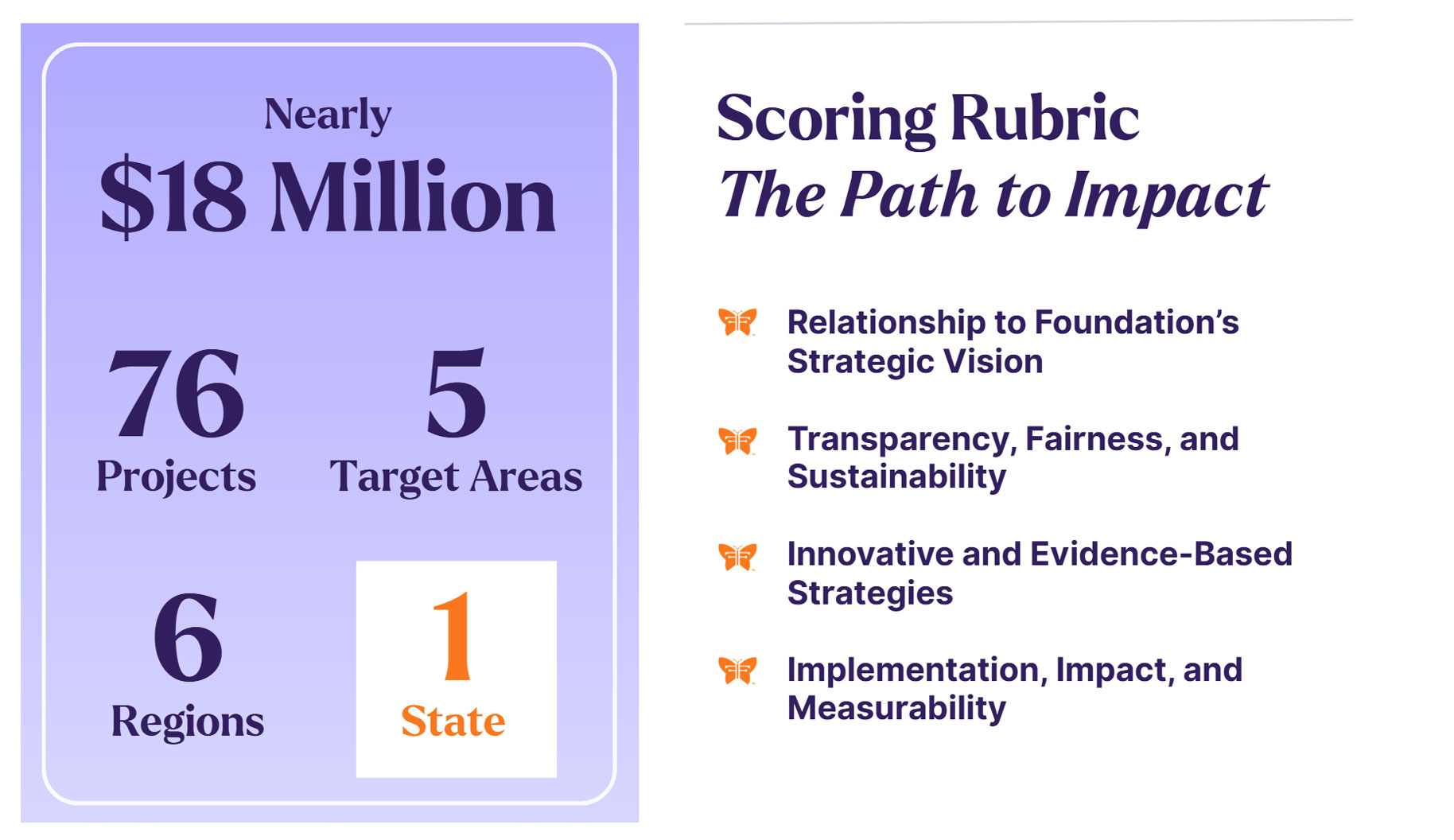
MIG Awardees Announced

Below you will find the formal Request for Applications (RFA), the FAQ information, and application details. Be sure to scroll through for Target Areas, available awards, the scoring rubric, timeline and more.

The MIG application period opened on September 22, 2025 and closed on October 10, 2025 at 12 p.m. (noon) EST.

Request for Applications

Access the full Request for Applications (RFA) for complete details on eligibility, requirements, funding priorities, and submission guidelines.

Grant Portal
Video Tutorial

This video is designed to guide you through the technical side of submitting your application. 

MIG Budget Template

All applicants are required to utilize this template when completing their application.

Target Areas

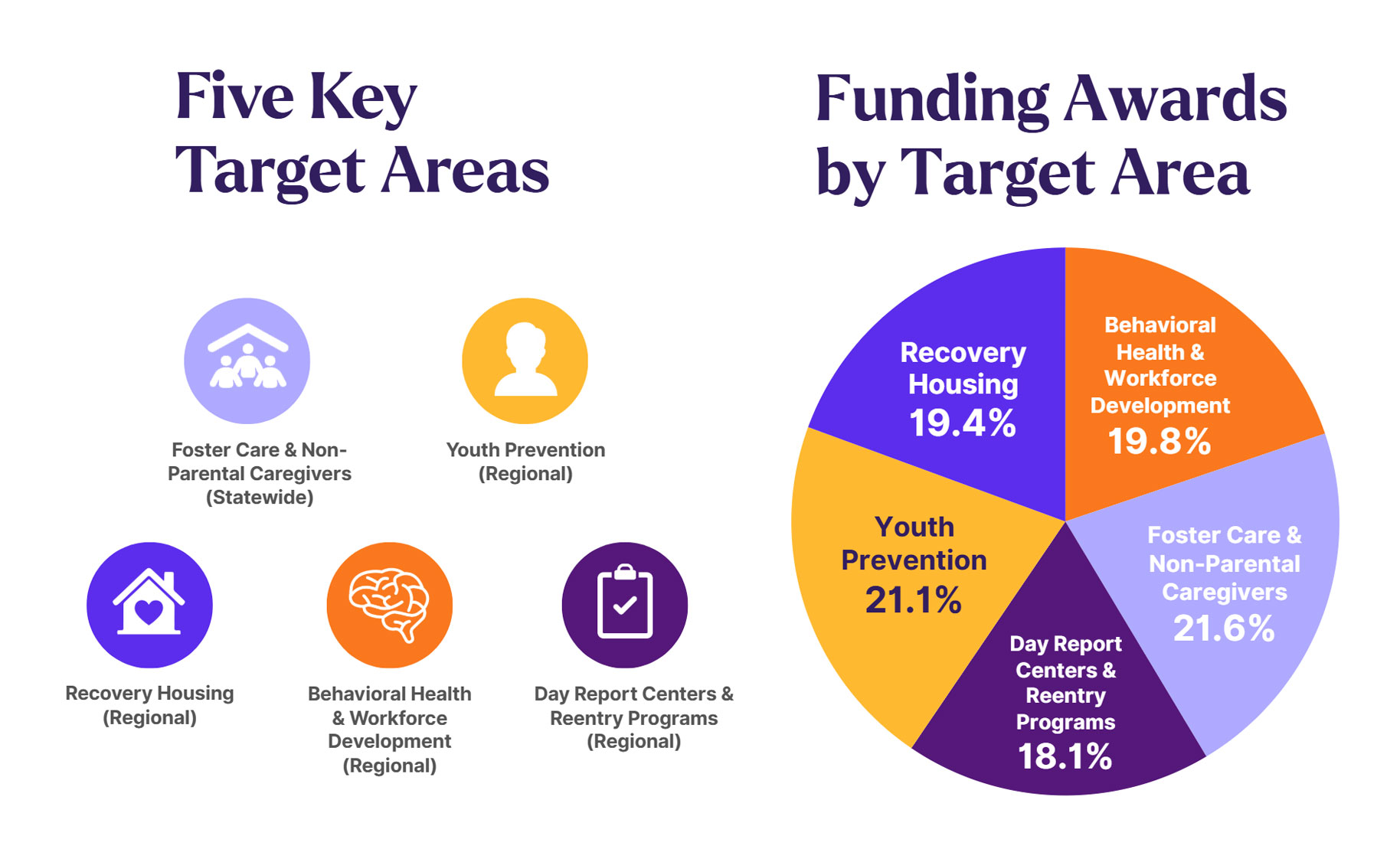
While the Momentum Initiative Grant (MIG) is not geography-based, its structure includes one statewide Target Area and four regional Target Areas. The statewide Target Area focuses on Foster Care and Non-Parental Caregivers, ensuring programs can reach across all of West Virginia. The remaining four Target Areas (Youth Prevention, Recovery Housing, Behavioral Health & Workforce Development, and Day Report & Reentry Programs) are designed to support projects with regional impact, allowing for broader distribution of resources while addressing diverse community needs.

Application Restrictions: Organizations can apply to the statewide Target Area and one other regional Target Area OR can apply to no more than three regional Target Areas. Applicants may only submit one application for their chosen Target Area(s). Statewide reach indicates demonstrated or planned impact and presence in all 6 regions of WV.

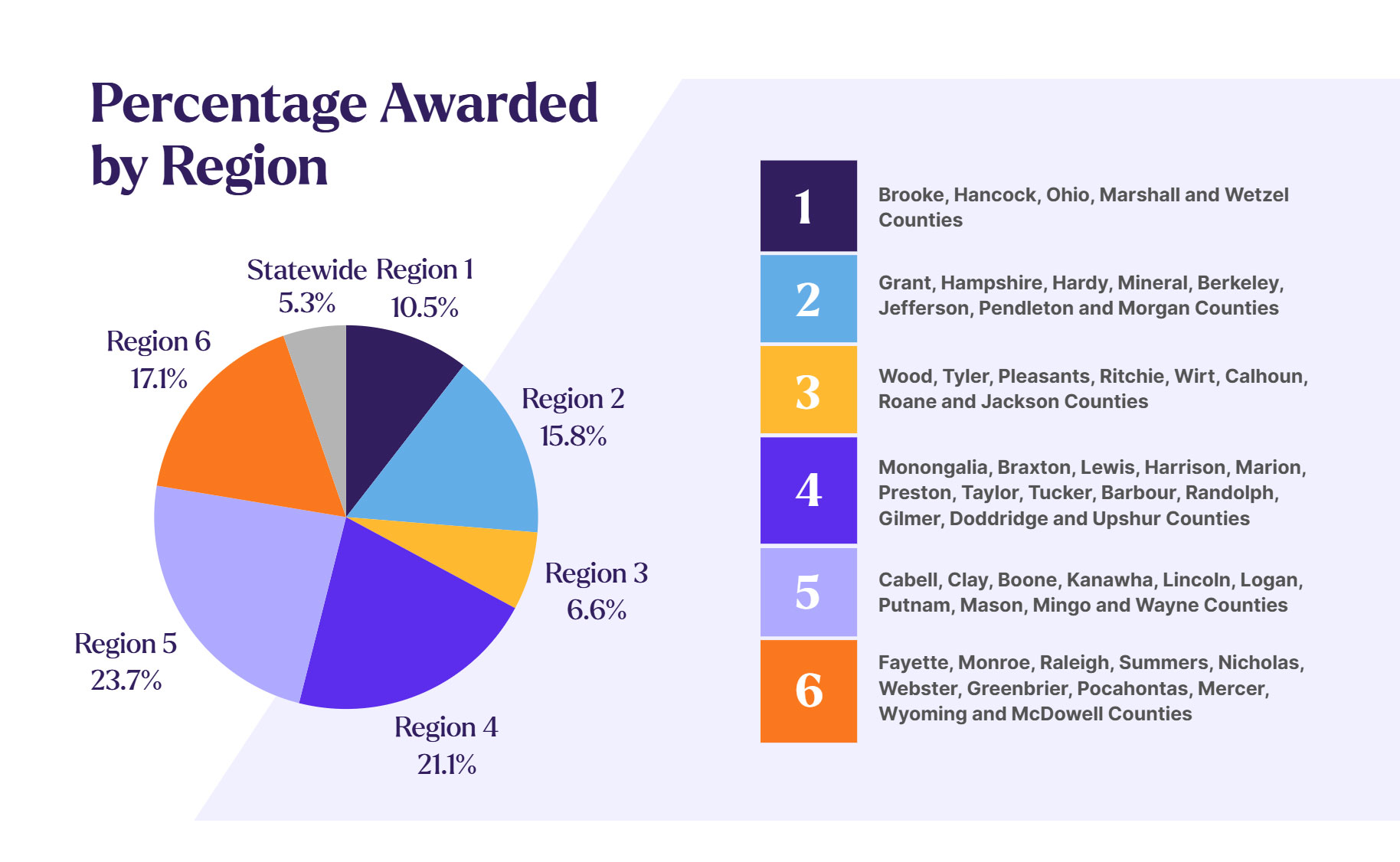
MIG map of 6 WVFF regions

Foster Care & Non-Parental Caregivers (Statewide Target Area) | $3.9M

  • Focus: West Virginia’s most critical child welfare challenges.
  • Eligible Programs: Foster care youth and non-parental caregivers (e.g., grandparents, relatives, guardians).
  • Awards: 4 total (2 foster care youth, 2 non-parental caregivers) at $975,000 each.
  • Requirement: Demonstrated capacity for statewide reach.
  • Eligibility: Open to nonprofit organizations, governmental entities, and for-profit organizations that partner with a nonprofit.

Youth Prevention (Regional Target Area) | $4M

  • Focus: Secondary prevention for at-risk youth, including those with high ACE scores, incarcerated parents, exposure to abuse, or foster care placement.
  • Eligible Programs: Structured, evidence-based, and community-led initiatives (e.g., Boys & Girls Clubs, mentoring, sports, arts, after-school models). Programming only; capital investments are not eligible.
  • Awards: 32 total at $125,000 each (total $4.0M).
  • Requirement: Must demonstrate measurable outcomes and prioritize the preferred age range of 8–13 years old.
  • Eligibility: Open to nonprofit organizations and governmental entities.

Recovery Housing (Regional Target Area) | $3.8M

  • Focus: Expansion of certified recovery residences to strengthen long-term recovery housing capacity across West Virginia.
  • Eligible Programs: New construction or home purchase projects designed to provide recovery housing (operational funding not eligible).
  • Awards: 10 total at $380,000 each (total $3.8M).
  • Requirement: Applicants must hold WVARR certification or be actively engaged in the certification process, with a strong emphasis on providing reentry support services.
  • Eligibility: Open to nonprofit organizations and governmental entities.

Behavioral Health & Workforce Development (Regional Target Area) | $3.75M

  • Focus: Building long-term behavioral health capacity through workforce development initiatives.
  • Eligible Programs:
    • Behavioral Health Workforce: Training and pipeline programs for psychiatrists, counselors, social workers, case managers, and related roles.
    • Employment Pathways: Apprenticeships, training, and credentialing programs that create new behavioral health professionals.
  • Awards: 15 total at $250,000 each (total $3.75M).
  • Requirement: Programs must directly contribute to new workforce creation, with emphasis on sustainability and long-term system capacity.
  • Eligibility: Open to nonprofit organizations and governmental entities.

Day Report Centers & Reentry Programs (Regional Target Area) | $3.75M

  • Focus: Strengthening services for court-ordered and post-incarceration populations to improve reentry success and reduce recidivism.
  • Eligible Programs: Day report centers and reentry programs that provide wraparound services, including support for transportation and programmatic gaps.
  • Awards: 15 total at $250,000 each (total $3.75M).
  • Requirement: Applicants must demonstrate measurable impact on reentry outcomes, including reduced recidivism, and must include wraparound programming.
  • Eligibility: Open to nonprofit organizations and governmental entities.

Funds must be used for Approved Purposes and Core Strategies as defined in the
West Virginia First Memorandum of Understanding (MOU).

Approved Purposes

  • Treat Opioid Use Disorder (OUD)
  • Support People in Treatment and Recovery
  • Connect People Who Need Help to the Help They Need (Connections to Care)
  • Address the Needs of Criminal-Justice-Involved Persons
  • Address the Needs of Pregnant or Parenting Women and Their Families, Including Babies with Neonatal Abstinence Syndrome
  • Prevent Over-Prescribing and Ensure Appropriate Prescribing and Dispensing of Opioids
  • Prevent Misuse of Opioids
  • Prevent Overdose Deaths and Other Opioid-Related Injuries
  • First Responders
  • Leadership, Planning and Coordination
  • Training
  • Research
  • Law Enforcement

Core Strategies

  • Naloxone or other FDA-Approved Drug to Reverse Opioid Overdoses
  • MAT Distribution and other Opioid Related Treatment
  • Pregnant and Postpartum Women
  • Expanding Treatment for Neonatal Abstinence Syndrome
  • Expansion of Warm Hand-Off Programs and Recovery Services
  • Treatment for Incarcerated Population
  • Prevention Programs
  • Evidence-Based Data Collection and Research Analyzing the Effectiveness of the Abatement Strategies within the State
  • Law Enforcement
  • Research

Scoring Methodology

The scoring methodology is divided into four key criteria, each aligned with best practices and evidence-based approaches. Each criterion is equally weighted at 25 points to reflect its importance in achieving WVFF’s guiding principles, with the total possible score of 100.

Scoring Rubric:

  1. Relationship to Foundation’s Strategic Vision (25)
  2. Transparency, Fairness, and Sustainability (25)
  3. Innovative and Evidence-Based Strategies (25)
  4. Implementation, Impact, and Measurability (25)

Relationship to Foundation's Strategic Vision (25)

Score

Description

5Little to no relationship to WVFF’s mission, vision, or grantmaking goals.
10Tangentially related but not directly aligned with WVFF’s mission, vision, or goals.
15Shows partial alignment with WVFF’s mission, vision, or goals but is inconsistent or incomplete.
20Aligns with most elements of WVFF’s mission, vision, or goals, but not all.
25Demonstrates strong alignment with WVFF’s mission, vision, and goals, with a clear path for achieving them through the proposed project.

Transparency, Fairness, and Sustainability (25)

Score       Description

5Mentions transparency, fairness, or sustainability without providing substantial plans or details.
10Provides minimal information on transparency, fairness, or sustainability; limited community involvement and little attention to long-term financial or operational viability.
15References transparency, fairness, and sustainability but lacks detailed plans. Some elements of community involvement or financial viability are present but incomplete.
20Includes plans for transparency and fairness with some mechanisms for community involvement. Provides partial strategies for sustaining the program financially or operationally over time.
25Clearly outlines transparent decision-making processes, fair and equitable access, meaningful community involvement, and robust plans for long-term sustainability, including financial viability and operational continuity beyond the grant.

Innovative and Evidence-Based Strategies (25)

Score          Description

5Lacks innovative and evidence-based strategies; no reference to relevant research or data.
10Few innovative or evidence-based strategies; relies mostly on untested methods.
15Mix of evidence-based and unproven strategies; limited explanation of how innovation or evidence will guide implementation.
20Mentions innovative and evidence-based strategies but lacks detail or comprehensiveness. Some strategies are supported by research, while others are less clearly grounded in evidence.
25Clearly describes the use of proven strategies supported by research, while also showing creativity in adapting or adding new approaches to meet community needs.

Implementation, Impact, and Measurability (25)

Score        
Description

5 Lacks a clear plan for implementation and evaluation. Goals are vague with no clear metrics, and no system for collecting data.
10 Provides a vague or incomplete implementation plan; unclear goals, evaluation measures, or basic data collection processes.
15 Includes a general implementation plan with some gaps. Evaluation is addressed but lacks detail or comprehensiveness. Data collection methods are limited or underdeveloped.
20 Presents a realistic implementation plan with timelines, resources, and stakeholder involvement. Includes some strategies for tracking outcomes and data collection, though not fully developed.
25 Provides a strong and realistic plan for implementation with clear timelines, resources, and partner roles. Explains how success will be tracked with clear, measurable goals and robust data collection systems to capture, monitor, and evaluate outcomes.

Timeline

RFA Published September 5
FAQ Submission Period September 5-September 12 (Noon)
Comprehensive FAQs & Video Tutorial
on New Grants Portal Published 
September 15
Application Period September 22-October 10 (Noon)
Review PeriodOctober 13 – December 4
Funding Vote by Board of DirectorsDecember 11
Applicants Receive NotificationOn or Before December 31


IMG_0323 (2)
demo-corporate-features-faq-icon

Frequently asked questions

FAQ submission period occurredSeptember 5, 2025 – September 12, 2025 at 12 p.m. (noon) EST 

Application period opened on September 22, 2025 and closed on October 10, 2025 at 12 p.m. (noon) EST

For efficiency, submitted questions were grouped and answered collectively. Please be aware that not every question appears verbatim, as similar inquiries may have been combined. 

 
What is the Momentum Initiative Grant (MIG)?

The MIG is the West Virginia First Foundation’s second major grant cycle, building on the success of the Initial Opportunity Grant (IOG). This $19.2 million investment focuses funding on high-impact projects designed to grow, strengthen, and create lasting change for West Virginians in the areas of prevention, recovery, and treatment.


How is the MIG different from the Initial Opportunity Grant (IOG)?

While the IOG was designed to quickly deploy funds to meet immediate needs across regions, MIG emphasizes merit-based awards, larger-scale investments, and long-term impact. Unlike IOG, MIG identifies award amounts and removes regional allocations to ensure funding supports the strongest proposals, regardless of geography.

Organizations that applied and/or received funding under the IOG are eligible to apply for the MIG. These applications will be treated as separate and new submissions, evaluated on their own merits.


When will the application open and close?

The application will open on September 22, 2025 and close at 12:00 PM (noon) EST on October 10, 2025. Applicants will be notified of their application status on or before December 31, 2025. 


How will applications be submitted?

Applications must be submitted through the WVFF Grant Portal which can be found on WVFF’s website. The portal will go live when the application opens on September 22, 2025 and will mirror the structure outlined in the Request for Applications (RFA), with all required fields and word count limits built directly into the system. 

Applicants will also upload the required attachments identified in the RFA, such as the budget template, IRS status documentation, and financial statements, within the portal. Only applications submitted through the Grant Portal will be accepted for review.


How many applications can an organization submit?

Applicants may submit:

  • One application in applicable Target Area, or
  • One application in the statewide Target Area and one application in a regional Target Area, or
  • Up to three applications in regional Target Areas

Applicants are not required to submit to multiple target areas; one strong application is sufficient. However, if an organization chooses to apply to multiple areas, they must submit a separate, full application for each.


How will applications be scored and reviewed?

Applications are scored using a rubric with four equally weighted criteria (25 points each – a total score of 100): Alignment with Foundation’s Strategic Vision, Transparency/Fairness/Sustainability, Innovative & Evidence-Based Strategies, and Implementation/Impact/Measurability. 

Applications are reviewed by the WVFF Regional Expert Panel, Statewide Expert Panel, and Board of Directors. Final awards are determined by the WVFF Board of Directors.

 
What are the Foundation’s expectations for sustainability and evidence-based strategies?

Applicants must show a clear plan for sustaining the project beyond the 12-month grant term. This includes identifying future funding sources and outlining realistic strategies for long-term viability. Evidence-based strategies are required, but applicants may adapt models to community needs as long as core components are preserved.


Should applicants submit IRS Form 990 or audited financial statements?

Applicants should submit the most recent IRS Form 990 (if applicable) or the most recent audited financial statements. If neither are applicable, the most relevant financial documents should be submitted and explained in said attachment. 


What constitutes “material” litigation?

“Material” litigation, regulatory, or legal proceedings refer to issues that could significantly affect the organization’s financial stability, operations, or ability to deliver the proposed program. Routine interactions with licensing or regulatory agencies – such as standard compliance inspections, minor or resolved citations, or corrective action plans that have been successfully completed – are not considered material.


What are the Core Strategies and Approved Purposes outlined in the MOU?

The MOU defines the Core Strategies and Approved Purposes as follows: 

Approved Purposes 

  • Treat Opioid Use Disorder (OUD)
  • Support People in Treatment and Recovery
  • Connect People Who Need Help to the Help They Need (Connections to Care)
  • Address the Needs of Criminal-Justice-Involved Persons
  • Address the Needs of Pregnant or Parenting Women and Their Families, Including Babies with Neonatal Abstinence Syndrome
  • Prevent Over-Prescribing and Ensure Appropriate Prescribing and Dispensing of Opioids
  • Prevent Misuse of Opioids
  • Prevent Overdose Deaths and Other Opioid-Related Injuries
  • First Responders
  • Leadership, Planning and Coordination
  • Training
  • Research
  • Law Enforcement


Core Strategies 

  • Naloxone or other FDA-Approved Drug to Reverse Opioid Overdoses
  • MAT Distribution and other Opioid Related Treatment
  • Pregnant and Postpartum Women
  • Expanding Treatment for Neonatal Abstinence Syndrome
  • Expansion of Warm Hand-Off Programs and Recovery Services
  • Treatment for Incarcerated Population
  • Prevention Programs
  • Evidence-Based Data Collection and Research Analyzing the Effectiveness of the Abatement Strategies within the State
  • Law Enforcement
  • Research


How much funding is available overall and in each focus area?

A total of $19.2 million is available through the MIG, distributed across five priority focus areas.

  • Foster Care & Non-Parental Caregivers – $3.9M
  • Youth Prevention – $4.0M
  • Recovery Housing – $3.8M
  • Behavioral Health & Workforce Development – $3.75M
  • Day Report Centers & Reentry Programs – $3.75M


What is the maximum award amount I can apply for in each Target Area?

Award amounts are fixed by Target Area as described in the RFA: Foster Care & Non-Parental Caregivers ($975,000 each), Youth Prevention ($125,000 each), Recovery Housing ($380,000 each), Behavioral Health & Workforce Development ($250,000 each), and Day Report & Reentry ($250,000 each). Applicants may not request more than the listed maximum.


What types of costs can be included in the grant budget?

Allowable costs vary by Target Area. Examples include: program staff salaries, program-specific operating expenses, supplies, and allowable capital expenses where applicable (e.g., Recovery Housing construction, renovation, and purchase). 

Unallowable costs can include debt repayment, ongoing operating expenses outside of program scope, etc. 

Applicants must use the Foundation’s required budget template. This file includes a budget narrative field, where applicants are required to briefly explain each line item.


What are the Foundation’s rules on indirect costs?

Applicants may allocate up to 10% of requested grant funds to indirect costs. Indirect costs are organization-wide expenses not directly tied to the project, such as administration, insurance, or shared utilities. Direct project costs, including staff directly tied to the program, may be included outside of this 10% cap.


How will grant funds be disbursed, and what reporting is required?

Funds are disbursed in four tranches: 40% upon award, and 20% at three subsequent milestones (40%, 20%, 20%, 20%), contingent on timely reporting and progress toward approved deliverables. Applicants must submit reports documenting both programmatic  and financial progress for tranche release.

For construction projects only: Construction invoices, whether in full or progress payments, will be reimbursed monthly upon presentation of an approved AIA payment application or contractor’s invoice to the Foundation. Any advance amounts paid will be deducted from future tranches of funding. 

For non-WVARR certified recovery residences only: The next tranche of payment will only be released if the Applicant demonstrates reasonable progress and completion of Foundation-provided milestones toward certification. These milestones will be defined in the Grant Agreement.


How long do applicants have to spend awarded funds, and are extensions available?

Funds must be expended within 12 months, though applicants may request a one-time extension (up to 6 months).


Is this funding opportunity considered a Federal Pass Through Grant?

No. West Virginia First Foundation is a private, nonprofit foundation.


What is the definition of Statewide and Regional projects?

Statewide projects (Foster Care & Non-Parental Caregivers) must demonstrate presence and impact across all six WVFF regions identified in the MOU, but do not need to operate in every county.

Regional projects must be submitted within the region where the project is based or headquartered. These projects do not need to cover the entire region, but they must clearly demonstrate impact within that region.


How should applicants determine the appropriate Target Area for their project?

Applicants should select the Target Area that best aligns with their project as defined in the RFA. Projects must fit clearly within one of the published Target Areas (Foster Care & Non-Parental Caregivers, Youth Prevention, Recovery Housing, Behavioral Health Workforce Development, Day Report & Reentry).

Applicants are responsible for clearly demonstrating how their proposed project and requested funds align with the selected Target Area as defined in the RFA.


Target Area Specifics

Foster Care & Non-Parental Caregivers (Statewide)


Overview:

  • Funding: $3,900,000 total, with 4 statewide awards of $975,000 each.
  • Scope: Supports both foster youth and non-parental caregivers (e.g., grandparents, kinship providers, guardians).
  • Goals: Reduce trauma, improve stability, and strengthen caregiver support.
  • Requirements: Applicants must demonstrate statewide reach, meaning presence and impact across all six WVFF regions identified in the MOU.


Who qualifies as a non-parental caregiver?

Grandparents, relatives, and guardians raising children outside of the foster care system.


What are the eligibility requirements for the Statewide Target Area?

Nonprofits may apply independently for the Foster Care & Non-Parental Caregivers Target Area. For-profit entities may only participate in partnership with a nonprofit, and only if the project is charitable in nature. The nonprofit must serve as a meaningful partner and ensure compliance with the Foundation’s charitable purpose and the MOU.


Youth Prevention (Regional)


Overview:

  • Funding: $4,000,000 total, with 32 regional awards of $125,000 each.
  • Scope: Supports community and school-based prevention programs.
  • Goals: Prevent initiation of substance use among youth, build resilience, and promote healthy development.


Why is the preferred age range 8–13 years old? Can you apply if the project is outside this range?

Research shows this is a critical window for prevention. Early intervention reduces long-term risk of substance use disorder. Projects outside of the preferred age range will still be considered.


Recovery Housing (Regional)


Overview:

  • Funding: $3,800,000 total, with 10 regional awards of $380,000 each.
  • Scope: Expands capacity of recovery housing across West Virginia.
  • Goals: Provide safe, supportive housing for individuals in recovery.
  • Requirements: Applicants must be WVARR-certified or actively pursuing certification.
  • Allowable Uses: New construction, property purchase, or substantial renovations. Ongoing operating expenses and debt repayment are not eligible, except indirect costs (capped at 10%).


What is WVARR certification? 

Certification from the West Virginia Alliance of Recovery Residences (WVARR), confirming quality and safety standards. 


What milestones will be identified in progress toward WVARR certification?

While the specific milestones will be defined in the Grant Agreement, applicants should expect these milestones to align with the WVARR certification process.


Behavioral Health & Workforce Development (Regional)


Overview:

  • Funding: $3,750,000 total, with 15 regional awards of $250,000 each.
  • Scope: Supports workforce development in behavioral health fields.
  • Goals: Address workforce shortages, strengthen system capacity, and build sustainable pipelines.


What types of programs are eligible?

Two tracks: (1) Behavioral Health Workforce Development (ex: psychiatrists, counselors, social workers, case managers, etc.), and (2) Employment Pathways (ex: apprenticeships, credential pipelines, job training, etc.).


Can funds be used to supplant payroll for existing staff?

No. Funding is intended to expand the workforce, not replace current resources.


Day Report Centers & Reentry Programs (Regional)


Overview:

  • Funding: $3,750,000 total, with 15 regional awards of $250,000 each.
  • Scope: Supports day report centers and reentry programs for justice-involved individuals.
  • Goals: Reduce recidivism, expand access to treatment, and support successful community reintegration.


What qualifies as “wraparound services”?

Services such as transportation, counseling, housing support, employment assistance, and case management.

For questions regarding the Momentum Initiative Grant (MIG), please contact grants@wvfirst.org.

Scroll