Program Overview
The Community Catalyst Grant (CCG) funds community-based programs across three Target Areas to reduce substance use, strengthen public safety responses, and support reentry and rehabilitation. The program invests $9.87 million over three years, with up to six awards per Target Area.
Building on previous grant cycles, the Community Catalyst Grant reflects a more strategic and data-driven approach to funding. With defined Target Areas, standardized metrics, and clear performance expectations, this cycle is designed to support programs that deliver measurable, long-term impact.
Applications are currently under review. They opened on June 1 and closed at Noon ET on June 30, 2026.
$9.87M
Total Funding
3-Year Grant Period
3 Target Areas
Up to 18 Total Awards

How To Apply
- Review eligibility and Target Areas
- Prepare required documentation
- Submit application between June 1-30, 2026
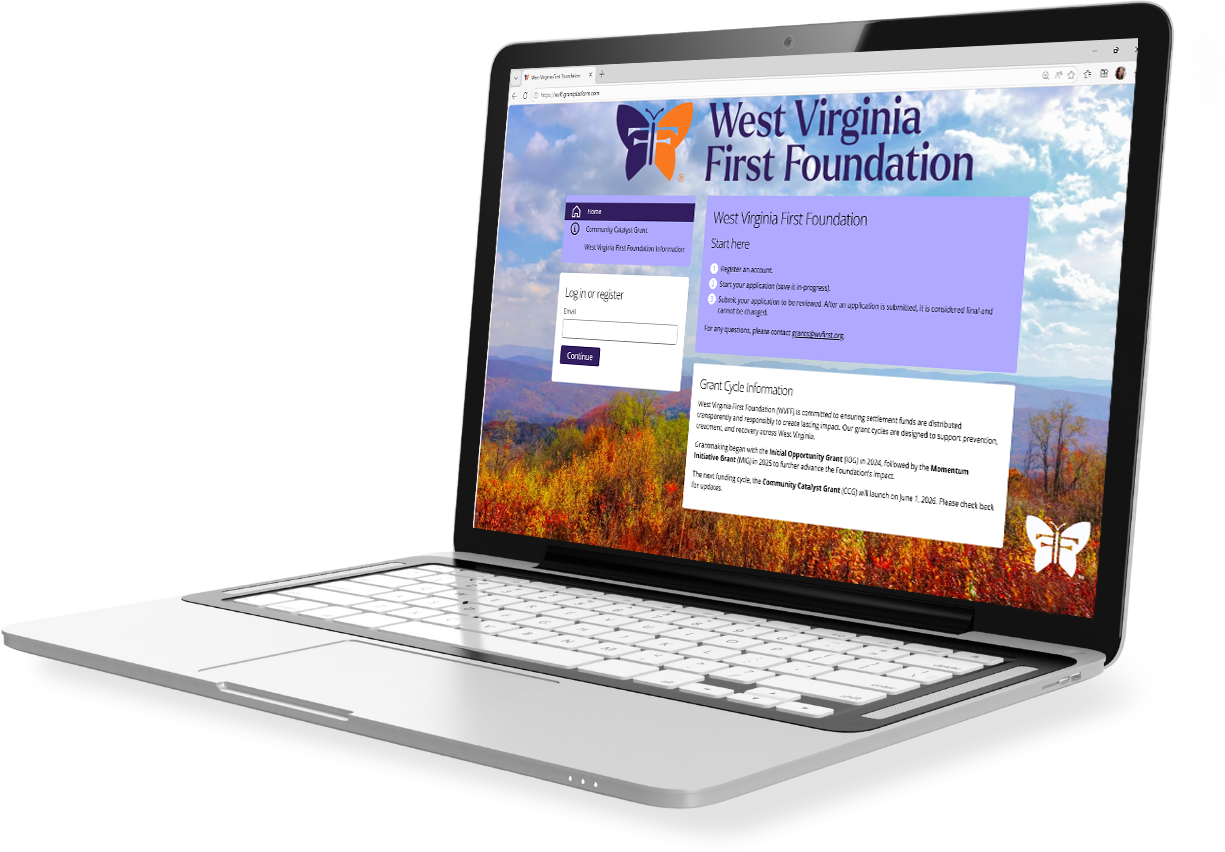
The Grant Portal opened for applications at midnight on June 1, 2026.
Applications were due no later than Noon ET on June 30, 2026.
Resources
The resources below are designed to help you understand eligibility requirements, prepare a strong application, and navigate the submission process with confidence.
Start with the Request for Applications (RFA), then use the additional resources below to support your application.
Before You Apply - All Applications MUST Meet the Following Requirements
- One application per organization
- One award per Target Area per region
- Must meet eligibility requirements for selected Target Area
- Funding is contingent upon grantees meeting yearly performance expectations
- Applications must clearly demonstrate measurable outcomes and data tracking capacity
Funds must be used for Approved Purposes and Core Strategies as defined in the
West Virginia First Memorandum of Understanding (MOU).
Application Materials
Request for Applications
Access the full Request for Applications (RFA) for complete details on eligibility, requirements, funding priorities, and submission guidelines.
CCG Required Budget Sheet
All applicants were required to utilize this template when completing their application.
Grant Portal
The Grant Portal opened for applications at midnight on June 1, 2026 and closed at Noon ET on June 30, 2026.
Application Support
Grant Portal Video Tutorial
This video provides technical instructions for registering an account on the West Virginia First Foundation Grant Portal.
Timeline
| RFA Published | May 13, 2026 |
| FAQ Submission Period | May 13 – 20, 2026 Due by Noon ET on May 20 |
| Comprehensive FAQs Published | May 26, 2026 |
| Application Period | June 1 – 30, 2026 Due by Noon ET on June 30 |
| Review Period | July – September, 2026 |
| Funding Vote by Board of Directors | December 2026 |
| Applicants Receive Notification | On or before December 31, 2026 |

Target Areas
Each Target Area addresses a critical component of prevention, response, or recovery. Click on a category below to explore eligibility, program focus, and required outcomes.
| Total Funding $3,000,006 | Duration 3 Years | Awards Up to 6 |
| Award Structure $166,667 per year | ||
- Law enforcement agencies
- Direct support agencies with certified or licensed staff embedded within law enforcement response systems
- Law enforcement agencies must have an active Memorandum of Understanding (MOU), or equivalent agreement, with a mental health, behavioral health, or direct support service provider
- Direct support agencies must have an active MOU, or equivalent agreement, with a participating law enforcement agency
- Embedded direct support professionals working with law enforcement
- Crisis response teams
- Expanded use of de-escalation strategies
- Training for officers responding to substance use crises
- Protocols that increase diversion to treatment or support services
| 01 | Improved law enforcement preparedness to respond to substance use crises |
| 02 | Increased effectiveness of de-escalation and crisis response training |
| 03 | Increased diversion from arrest to treatment or support services |
| 04 | Reduction in justice system costs associated with incarceration and repeated crisis response |
- Number of hospital transports resulting from substance use crisis calls
- Number of injuries occurring during calls for service (officers, individuals in crisis, or others)
- Repeat law enforcement calls involving the same individual experiencing a substance use crisis
- Arrests
- Arrest Count: Total number of arrests resulting from crisis calls
- Arrest Rate: (Number of Arrests / Total Crisis Calls) x 100
- Diversion
- Diversion Count: Number of individuals diverted to treatment or support services in lieu of arrest
- Diversion Rate: (Number of Diversions / Eligible Crisis Calls) x 100
- Number of overdose incidents responded to by law enforcement
- Number of overdose incidents entered into an OD Mapping or equivalent data system
- Number of mental health-related calls for service
- Number of referrals made to:
- Substance use treatment services
- Behavioral health services
- Housing or shelter services
- Number of successful service connections, defined as confirmation that the individual engaged with the referred service (where data sharing agreements allow)
- Number of Handle With Care (HWC) submissions completed following qualifying incidents involving children exposed to trauma
- Commit to full implementation within Year 1 of the grant period
- Describe their implementation plan, including coordination with schools or partner agencies
- Pre-training survey establishes baseline preparedness, knowledge, and confidence
- Post-training survey assesses changes following training
- Ongoing Survey (recommended) may be administered annually to assess retention
- I am prepared to handle a substance use crisis
- I have the training necessary to respond to a substance use crisis
- I have the skills to de-escalate individuals experiencing a crisis
- I understand when and how to divert individuals to treatment or support services
- I am confident coordinating with service providers during a crisis response
- I would benefit from additional training related to responding to substance use crises
- General de-escalation training
- Training related to responding to substance use crises
- Protocols for responding to calls involving individuals experiencing an acute substance use crisis
- Percentage of participating officers trained in:
- Crisis Intervention Team (CIT), and/or
- Mental Health First Aid or equivalent
- Total number of officers completing crisis response-related training annually
- Establish baseline across all required quantitative measures
- Implement required data collection and reporting systems
- Administer pre-training officer preparedness surveys to establish baseline
- Demonstrate increased diversion rates in lieu of arrest, where appropriate
- Demonstrate increased number and rate of referrals to treatment, behavioral health, and support services
- Demonstrate increased use of de-escalation strategies during crisis response
- Achieve threshold of 60% of participating officers trained in crisis response-related training (e.g., CIT, Mental Health First Aid, or equivalent)
- Demonstrate improvement in officer preparedness, confidence, and perceived ability to respond to substance use crises, as reflected in post-training survey results
- Demonstrate sustained or increased rate of successful service connections
- Achieve threshold of 75% of participating officers trained in crisis response-related training (e.g., CIT, Mental Health First Aid, or equivalent)
- Demonstrate continued improvement in officer preparedness and de-escalation capacity, as reflected in ongoing survey results
| Programs supported under this Target Area must improve the effectiveness of law enforcement crisis response while expanding diversion opportunities and strengthening connections to treatment and support services. Over time, these efforts are expected to reduce repeat crisis calls, decrease reliance on arrest and incarceration, improve safety outcomes during crisis response, strengthen coordination between law enforcement and service providers, and reduce system burden associated with crisis response and justice system involvement. |
| Total Funding $3,000,006 | Duration 3 Years | Awards Up to 6 |
| Award Structure $166,667 per year | ||
Purpose
The Day Report Centers Target Area supports programs that provide structured supervision, treatment coordination, and rehabilitation services for individuals involved in the criminal justice system. The goal of this Target Area is to strengthen the effectiveness of Day Report Centers in reducing recidivism and supporting successful reentry into the community.
Programs funded through this Target Area are expected to demonstrate measurable outcomes related to recidivism reduction and program effectiveness. Funding will prioritize programs that use consistent and reliable methods to track participant outcomes over time.
Eligible Applicants
Eligibility for this Target Area is limited to Day Report Centers that provide services to individuals involved in the criminal justice system.
Applicants must demonstrate their capacity to monitor participant outcomes and maintain accurate records related to program participation and recidivism.
Program Focus
Programs supported under this Target Area must provide services that promote accountability, rehabilitation, and successful community reintegration. These services may include:
- Structured supervision and reporting requirements
- Treatment and behavioral health referrals
- Substance use treatment coordination
- Workforce development and employment support
- Life skills and rehabilitation programming
Programs must demonstrate how their services contribute to reducing repeat involvement in the criminal justice system.
Key Outcome Areas
Funded programs are expected to achieve defined performance thresholds in the following areas:
| 01 | Reduction in recidivism among program participants |
| 02 | Improved tracking and reporting of recidivism outcomes |
| 03 | Implementation of consistent recidivism monitoring practices across programs |
Required Application Questions
Program Measurement & Tracking
- How does your program currently measure success?
Participant Intake & Outcomes
Applicants must provide the following data for Fiscal Years 2024 and 2025:
- Number of new admissions
- Number of discharges due to noncompliance
- Number of program graduates (successful completions)
Applicants must also provide a brief explanation of any significant trends, changes, or anomalies observed across these reporting periods, including factors that may have influenced program performance.
Recidivism Tracking Practices
- Do you conduct criminal background checks on new referrals to determine eligibility?
- Do you conduct criminal background checks on program graduates to monitor recidivism?
Core Quantitative Measures
Applicants will track measurable changes in participant outcomes and program effectiveness. Metrics must demonstrate progress in reducing recidivism, improving program completion, and strengthening outcome tracking practices. WVFF may review submitted data, supporting documentation, and reporting practices to ensure compliance with measurement and reporting requirements.
Core Operational Measures
Applicants must track:
- Number of new admissions
- Number of program graduates (successful completions)
- Number of discharges due to noncompliance
Standardized Rate-Based Measures
To ensure comparability across programs, applicants must report both counts and rates for the following:
- Program Completion
- Completion Count: Number of program graduates
- Completion Rate: (Number of Graduates / Total Admissions) x 100
- Noncompliance
- Noncompliance Count: Number of discharges due to noncompliance
- Noncompliance Rate: (Noncompliant Discharges / Total Admissions) x 100
- Recidivism
- Recidivism Count: Number of program participants who are rearrested, reconvicted, or reincarcerated within a defined timeframe
- Recidivism Rate: (Number of Participants with Recidivism Events / Total Participants Tracked) x 100
Applicants must clearly define the recidivism measurement period (e.g., 6 months, 12 months post-program) and the type of recidivism tracked (rearrest, reconviction, and/or reincarceration).
Compliance Requirements
Programs funded through this Target Area must comply with the following requirements:
- Agencies must currently conduct, or commit to implementing within the first year, criminal background checks on new program referrals and program graduates for the purpose of tracking recidivism
- Agencies must maintain supporting documentation for all reported outcomes
- Agencies must retain program data and documentation for the duration of the funding agreement, and potentially longer if required for audit purposes
- Agencies must commit to continued tracking of participant outcomes, including recidivism, beyond the grant period
- Awarded agencies will be subject to audit to verify compliance with reporting and outcome tracking requirements
Performance Expectations
Year 1: Establish baseline performance and implement required tracking and reporting systems
- Establish baseline recidivism rates and implement required tracking mechanisms
- Implement or enhance a formal recidivism tracking system
Year 2: Demonstrate measurable improvement from baseline
- Achieve a minimum 5% reduction in recidivism from baseline
- Maintain consistent reporting and demonstrate improved completeness and reliability of outcome data
Year 3: Demonstrate sustained and increased improvement from baseline
- Achieve a minimum 10% reduction in recidivism from baseline
- Demonstrate sustained consistency and reliability of outcome data reporting
Programs must use a defined recidivism measurement period, maintain consistent data collection practices, and retain documentation to support reported outcomes.
Expected Impact
| By strengthening outcome measurement and recidivism tracking within Day Report Centers, this Target Area aims to improve program accountability and ensure that funded services contribute to measurable reductions in repeat involvement with the criminal justice system. Over time, these efforts are expected to reduce recidivism among program participants, improve program completion outcomes, strengthen consistency and reliability of outcome tracking, support more effective rehabilitation services, and improve long-term reentry outcomes for participants. |
| Total Funding $3,870,000 | Duration 3 Years | Awards Up to 6 |
| Award Structure $215,000 per year | ||
Purpose
The Generational Prevention Target Area supports community-based systems of care designed to identify adolescents at risk for substance use and intervene early through coordinated prevention, screening, treatment, and recovery services.
This approach recognizes that youth substance use and behavioral health challenges are influenced by individual, family, and community factors, including trauma exposure, mental health conditions, family substance use, and social determinants of health. Programs funded under this Target Area are expected to engage youth and caregivers simultaneously in services that strengthen protective factors and reduce risk conditions across generations.
Program Model
Applicants funded through this Target Area will implement the CATALIST (Community-based Assessment and Treatment for Adolescents & Families to Launch Interventions for Substances & Trauma) model, which integrates prevention, early intervention, treatment, and recovery services for adolescents ages 12-18 and their caregivers.
The model leverages community infrastructures such as schools, juvenile justice systems, emergency departments, and community-based organizations to identify youth who may be experiencing or at risk for substance use or co-occurring behavioral health conditions.
Programs are expected to implement coordinated services across multiple systems and utilize evidence-based strategies to support youth and their families.
Training and Technical Assistance
To support successful implementation and fidelity to the CATALIST model, grantees will receive centralized Training and Technical Assistance (TTA).
TTA will be provided by a designated qualified provider with experience in evidence-based behavioral health implementation and evaluation, and will include:
- Model orientation and implementation guidance
- Training on screening, assessment, and evidence-based interventions
- Ongoing implementation support and coaching
- Data collection, evaluation, and reporting support
- Continuous quality improvement (CQI) processes
Program Focus
Programs funded through this Target Area must focus on:
- Early identification of adolescents at risk
- Universal and targeted screening
- Early intervention services
- Evidence-based treatment and recovery supports
- Integration of caregivers into services
Key Outcome Areas
Funded programs are expected to achieve defined performance thresholds in the following areas:
| 01 | Improved identification and screening of youth at risk |
| 02 | Reductions in risk factors (substance use, depression, anxiety, trauma) |
| 03 | Increased protective factors (resiliency, belonging, family functioning) |
Core Quantitative Measures
Data Collection and Reporting Responsibilities
Grantees are responsible for the collection, entry, and maintenance of all required program and participant-level data, including administration of standardized screening and assessment tools aligned with the CATALIST Measure Set and tracking of service engagement and outcomes.
Data analysis, aggregation, and reporting will be supported through the designated Training and Technical Assistance (TTA) provider, including development of standardized dashboards and cross-site evaluation.
Applicants will track measurable changes in access, engagement, and participant outcomes.
Access to Services
- Eligible Youth Identified: Number of youth who meet eligibility criteria based on standardized screening and assessment tools
- Youth Served: Number of eligible youth who receive services
- Access Rate: (Youth Served / Eligible Youth Identified) x 100
Eligibility must be determined in accordance with the Eligible Youth definition in the definitions section, using standardized screening and assessment tools aligned with the required CATALIST Measure Set.
Applicants must demonstrate that:
- All youth meeting eligibility criteria are offered services
- No eligible participants are turned away due to program capacity limitations
WVFF may review screening, referral, and enrollment data to ensure eligibility criteria are applied consistently and that access requirements are met.
Screening Coverage
- Number of youth screened
- Percentage of youth screened within target settings
Screening must be applied consistently within identified target settings, as defined in the definitions section.
Service Engagement & Retention
- Percentage of youth who begin services after referral
- Percentage of youth completing defined service milestones
Service milestones must be clearly defined and consistently applied, as outlined in the definitions section, and may be reviewed by WVFF to ensure consistency across reporting periods.
Risk Reduction
Percentage of youth demonstrating improvement in:
- Substance use
- Depression
- Anxiety
- Trauma symptoms
Protective Factors Improvement
Percentage of youth demonstrating improvement in:
- Resiliency
- Belonging
- Family functioning
Performance Expectations
Year 1: Establish baseline performance and implement required tracking and reporting systems
- Implement full model and measure set
- Establish baseline performance
- 80% or greater data completeness
Year 2: Demonstrate measurable improvement from baseline
- 5% or greater improvement from baseline
- 85% or greater data completeness
- Maintain access compliance
Year 3: Demonstrate sustained and increased improvement from baseline
- 10% or greater improvement from baseline
- 90% or greater data completeness
- Maintain access compliance
Evaluation & Reporting
Evaluation will be integrated throughout implementation, with the designated TTA provider conducting:
- Continuous quality improvement (CQI) reviews
- Fidelity assessments
- Long-term qualitative follow-ups with participating youth
De-identified dashboards will be provided quarterly to each grantee to support ongoing program refinement and performance monitoring.
Assessment Requirements
Applicants must:
- Conduct baseline assessments at program entry
- Conduct reassessments at defined intervals (e.g., 3 and 6 months)
- Use assessment data to track change over time and inform care planning
CATALIST Measure Set
Applicants must implement the full CATALIST Measure Set to assess youth and track outcomes over time.
Assessment Grid
| Domain | Tool | Measure Focus | Use Case |
| Strengths | Strength-based items | Positive coping | Baseline |
| Social Needs | Social Needs Screening Tool | Social determinants | Universal |
| Substance Use | S2BI | Use frequency | Universal |
| CRAFFT | Behavioral impact | Secondary | |
| Depression | PHQ-9 | Symptoms | Screening |
| Anxiety | GAD-7 | Symptoms | Screening |
| Trauma | CPSS-V-SR | PTSD symptoms | Assessment |
| Family Risk | Familial substance use | Exposure | Screening |
| Family Risk | Familial mental health | Exposure | Screening |
| Resiliency | CYRM | Coping | Full assessment |
| Belonging | Belongingness Scale | Social connection | Full assessment |
| Family Functioning | FACES-III | Cohesion | Full assessment |
| Behavioral Risk | GAIN-SS | Externalizing behaviors | Full assessment |
| Adverse Experiences | ACE-Q | Trauma exposure | Full assessment |
Expected Impact
| Programs supported through this Target Area aim to increase early identification of at-risk youth, expand access to services without capacity barriers, reduce behavioral health risk factors, strengthen protective factors, and interrupt intergenerational cycles of substance use. |
Scoring Methodology
The scoring methodology is divided into four criteria designed to evaluate the potential of proposed projects to catalyze community-driven solutions, strengthen partnerships, and advance the Foundationʼs strategic priorities. Each criterion is equally weighted at 25 points, for a total possible score of 100 points.
Scoring Rubric:
- Alignment with Target Area and the Foundation Strategic Vision (25)
- Innovative and Evidence-Based Strategies (25)
- Community Partnership and Equitable Engagement (25)
- Implementation Capacity, Impact, and Sustainability (25)
Alignment with Target Area and the Foundation Strategic Vision (25)
| Score | Description |
| 1-5 | Demonstrates little or no connection to the designated Target Area or the Foundationʼs strategic vision. |
| 6-10 | Shows limited alignment with the Target Area or the Foundationʼs strategic vision; the connection is weak or unclear. |
| 11-15 | Demonstrates partial alignment with the Target Area and the Foundationʼs strategic vision but lacks clarity or completeness in how the project addresses them. |
| 16-20 | Aligns well with the Target Area and the Foundationʼs strategic vision and identifies relevant issues supported by data, experience, or stakeholder input. |
| 21-25 | Demonstrates strong and clear alignment with the Target Area and the Foundationʼs strategic vision, with a compelling explanation of how the proposed project advances the Foundationʼs mission and strategic goals. |
Innovation and Evidence-Based Strategies (25)
| Score | Description |
| 1-5 | The proposal relies on traditional or routine approaches with little potential for broader impact, systems change, or use of evidence-based practices. |
| 6-10 | Demonstrates some innovative elements but lacks clarity on how the project will create broader community impact. |
| 11-15 | Demonstrates some innovative elements and references evidence-based or evidence-informed approaches, but lacks clarity on how the project will create broader community impact or sustainable change. |
| 16-20 | Shows innovative thinking or new approaches that incorporate evidence-based or promising practices and have potential to influence community practices, partnerships, or systems-level outcomes. |
| 21-25 | Demonstrates a highly innovative or catalytic approach grounded in evidence-based and/or evidence-informed practices. The project has strong potential to spark new solutions, strengthen systems, influence policy or partnerships, and inspire broader community change beyond the scope of the grant. |
Community Partnership and Equitable Engagement (25)
| Score | Description |
| 1-5 | Little evidence of community engagement, collaboration, fairness, or transparency in planning or implementation. Limited involvement of partners or stakeholders. |
| 6-10 | Mentions partnerships, community engagement, or transparency practices but provides limited detail regarding meaningful involvement, equitable participation, or decision-making processes. |
| 11-15 | Includes some partnerships or stakeholder involvement and identifies efforts toward fairness or transparency, but lacks clear roles, consistent communication, or meaningful integration of community input. |
| 16-20 | Demonstrates meaningful collaboration with community partners, including shared roles, community input, and transparent processes. Shows consideration for equitable participation and fair decision-making practices. |
| 21-25 | Shows strong, authentic collaboration with diverse partners and stakeholders, including individuals with lived experience. Community voices are meaningfully integrated into planning, implementation, and decision-making. Demonstrates clear commitments to fairness, equity, transparency, and accountability through open communication, inclusive practices, and well-defined decision-making processes. |
Implementation Capacity, Impact, and Sustainability (25)
| Score | Description |
| 1-5 | Lacks a clear implementation plan, measurable outcomes, or demonstrated organizational ability to successfully perform the proposed activities. Goals are vague and difficult to assess. |
| 6-10 | Includes a basic implementation plan but lacks clear timelines, defined responsibilities, evaluation methods, or demonstrated implementation capacity. |
| 11-15 | Provides a general implementation plan with some measurable goals and demonstrates limited implementation experience or operational readiness, though evaluation and sustainability planning remain limited. |
| 16-20 | Presents a realistic implementation plan with defined timelines, roles, evaluation strategies, and demonstrated organizational capacity to implement and manage the proposed activities. |
| 21-25 | Provides a strong implementation plan with clear timelines, defined responsibilities, measurable outcomes, demonstrated organizational ability to successfully implement and manage the proposed activities, and a thoughtful strategy for sustaining impact beyond the grant period. |
Questions? Contact grants@wvfirst.org.